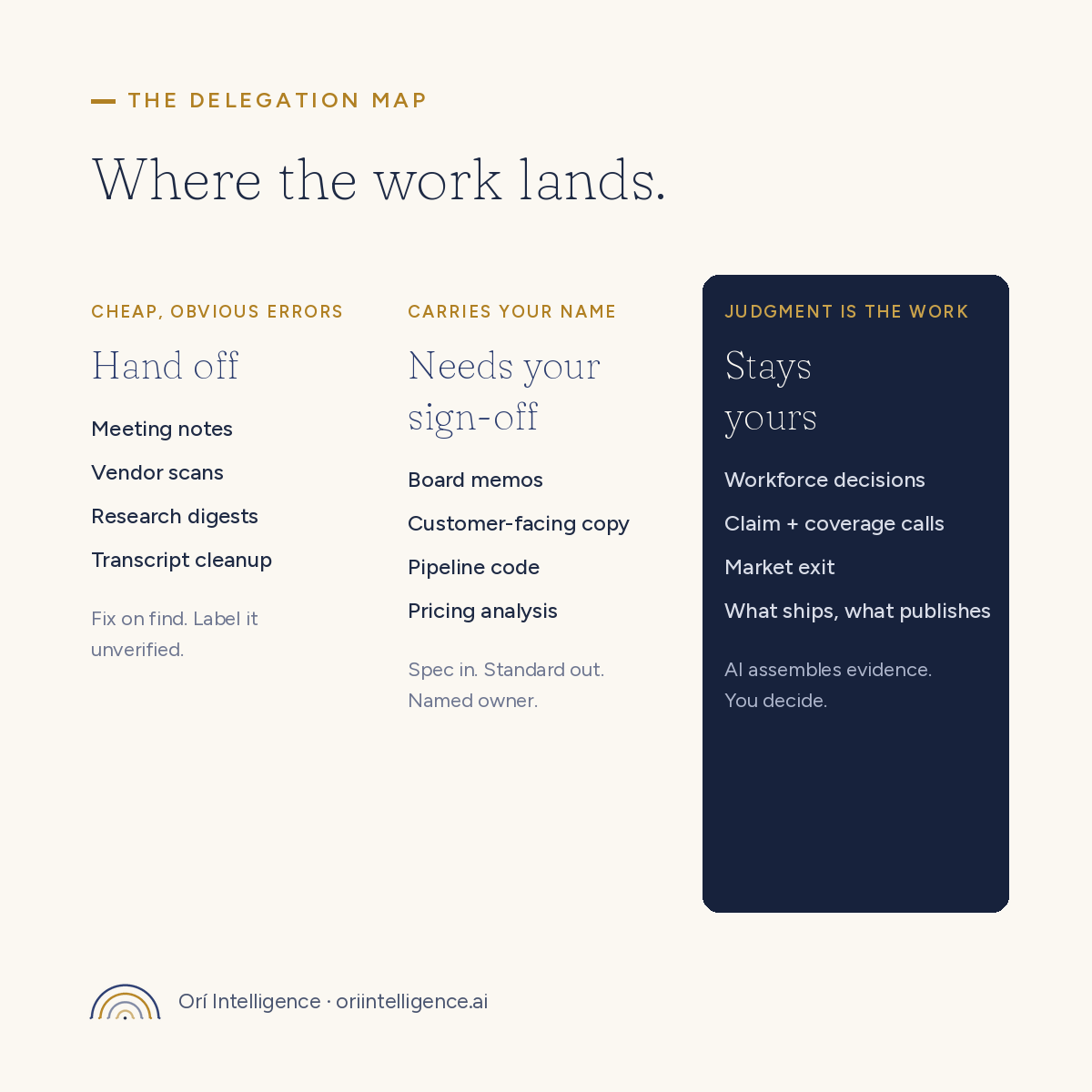
The Delegation Map
What to hand off, what needs your sign-off, and what stays yours.

An Orí playbook. Built from my own operation, free to use
I once authorized an AI build with the format living unstated in my head. The go-word was clear, the intent was not, and the deliverable came back built to a spec the system had assumed on my behalf. It was rebuilt after the fact, which means it was built twice, and the second build only existed because I skipped one sentence describing what I actually wanted.
That failure taught me the thing I open every executive session with. The failure mode is rarely delegating too much. It is delegating vaguely. Organizations pay for the same skipped sentence at scale: AI work built to an assumed spec, with the mismatch surfacing after the work is done and nobody on record as having decided the spec.
So before AI touches a piece of my work, it gets sorted. Three buckets, three sorting questions, and the sort takes less time than one round of rework. This is the same map I build with executives in the room, on their real workload. Here is how it runs on mine.
Bucket one: hand off
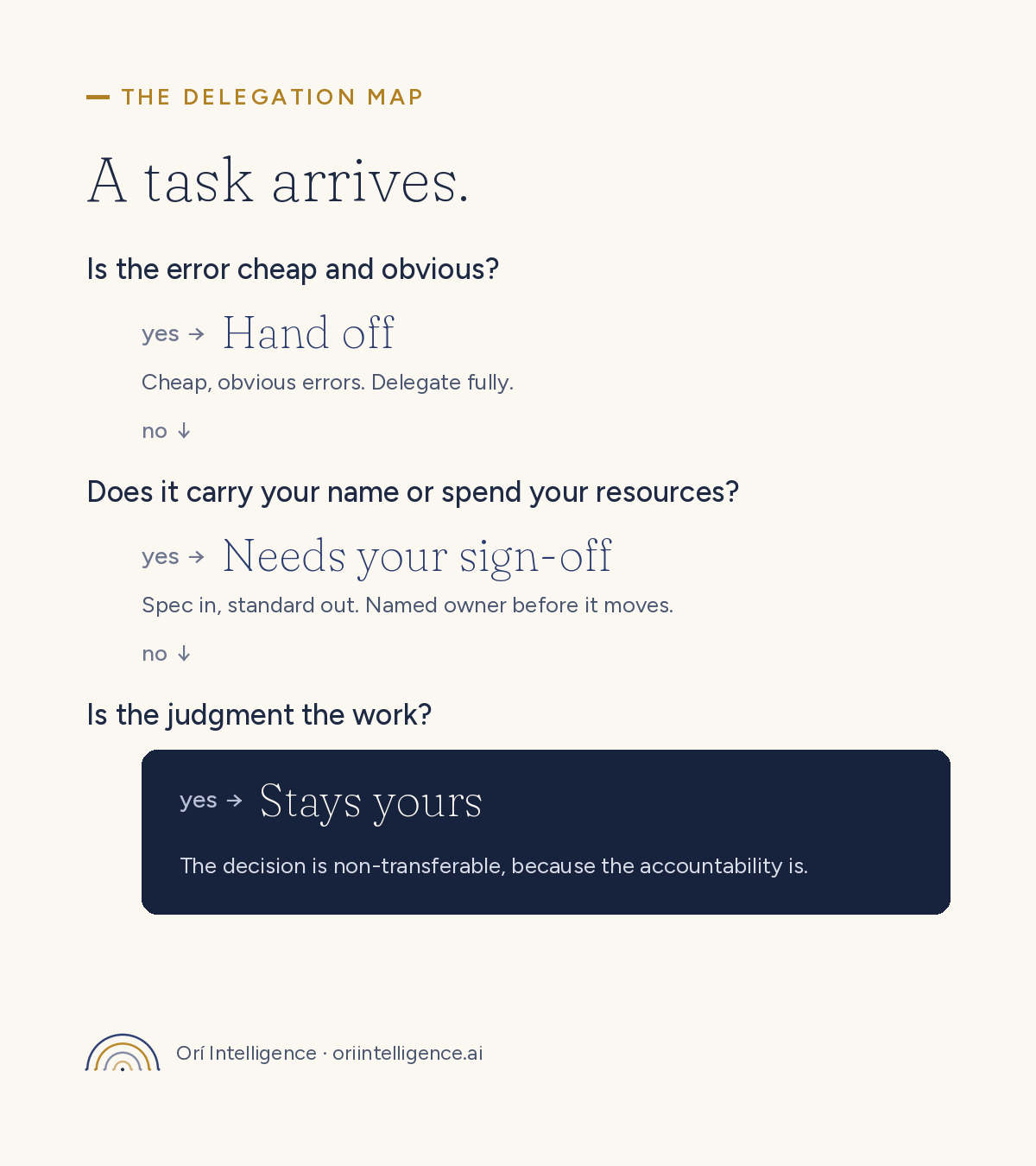
The sorting question: if this is wrong, is the error cheap and obvious?
Work goes here when a mistake costs minutes, not credibility, and when I would catch the mistake on sight without expertise or effort. First-pass research lives here. Transcript cleanup lives here, because I dictate first and clean up second, and a mangled sentence announces itself. Inventorying the checkable claims in a draft lives here too. Pulling the list of claims is mechanical work. Judging them takes expertise, and that happens two buckets up.
Obvious is the half people skip. An error is obvious when it announces itself in the reading: the mangled sentence, the wrong date in a timeline you know, the summary that contradicts the meeting you sat in. An error is not obvious when it looks fine and happens to be wrong: the plausible statistic, the citation that formats perfectly and does not exist. Those errors are sometimes cheap. They are never obvious, so their work does not belong here.
Notice what does not qualify: anything where the error would be expensive, invisible, or carrying my name. The error has to be both cheap and obvious, and one without the other moves the work up a bucket.
The organizational version of this bucket holds meeting summaries, first-pass vendor scans, and internal research digests. Written as team rules, the sorted decision reads like this:
AI-generated meeting notes circulate without review; whoever spots an error fixes it in the doc.
First-pass vendor research goes straight to the shared channel, labeled unverified.
That unverified label marks the bucket, so nobody downstream mistakes a hand-off for a signed-off fact. And the same wrong line that costs a correction here costs trust in a customer email, which is why the customer email lives in the next bucket.
Bucket two: needs your sign-off
The sorting question: does this carry my name or spend my resources?
Most of my working week lives here, and this bucket is the reason the map exists at all. Sign-off is not a vibe. It is a written checkpoint, and it runs at both ends of the handoff. At entry, the work gets specified before it starts: what will be built, in what format, for what use. At exit, the output passes a standard before it moves. Mine are standing rules: state the spec in one or two lines before any build, verify checkable claims before asserting them, distinguish documented from contested, apply the voice standard, flag what remains uncertain.
That rebuilt deliverable in my opening failed at entry. I authorized the work and skipped the format sentence, so the exit review had nothing to catch, because the output matched the spec the system assumed.
A checkpoint earned its keep in one of my own newsletter drafts. Every issue I write runs through a final claims check before it publishes: each checkable assertion in the draft gets verified against its source. In one draft I had quoted a line attributed to Adam Smith because it gave me exactly the argument I wanted about precolonial African societies. The verification pass traced it to The Wealth of Nations and found a modern paraphrase of a passage that said something different in openly derogatory language. The line came out, the paragraph was worse for it, and the issue shipped without it, because the checkpoint was written down before I was attached to the sentence.
In practice that means writing two things down before the machine starts: the spec for what you want built, and the standard the output has to pass before it moves. Write both while you are calm, because you will be applying them when you are not.
Organizations already run this bucket for human work. “We do not ship without sign-off” survives every deadline for a reason. The AI version is the same gate with the standard made explicit. Written down, the sorted decision reads like this:
No AI-assisted work starts until the requester states, in writing, what will be built, its format, and where it will be used.
No code from the AI automation pipeline deploys without review by an engineer who owns the outcome.
No customer-facing copy sends until a named owner has checked every claim against what the product actually does.
AI-drafted analysis can feed a pricing recommendation only if the memo states which numbers were verified and by whom.
If your team cannot say who signs and against what, the work is not in this bucket. It is unsorted, which in practice means it is in bucket one by default and nobody chose that.
Bucket three: stays yours
The sorting question: is the judgment the work?
Some tasks produce an output, and the judgment rides along. Other tasks are the judgment. Which product ships. What gets published under my name at all. Whether a client engagement is a fit. The premise underneath a plan. An organization sorts the same way: layoffs, pricing, exiting a market, and ending a vendor contract all held in this bucket, no matter how strong the model’s recommendation looks. AI can assemble the evidence for every one of these, list what supports the recommendation and what would require specialist review. It does not get the decision, because the accountability cannot go with it, and I write that boundary down so it holds when I am tired.
Written down, the sorted decision reads like this:
No workforce decision is made or announced on an AI recommendation alone; the accountable executive decides and signs.
No claim denial or coverage call is decided by a model; the system assembles the file, and a person decides it.
The board minutes for a market exit record who decided, and it is never a tool.
I learned where this line sits by nearly crossing it. During a company launch, I proposed a fifth product for an audience I had already deprioritized, and I brought it to the system as a planning task. Planning is bucket two work. The decision to add a product mid-launch was bucket three work, and I had smuggled it in wearing a task’s clothes. My own standing rule caught it, flagged the overcommitment pattern I had declared, and handed the decision back to me. I postponed the product. The system did not decide that. It refused to let me pretend I already had.
That is the real function of the third bucket. It is not a fence against the machine. It is a fence against your own tendency to delegate a decision by dressing it as a deliverable.
Running the sort
Take your recurring work, the tasks that fill an actual week, and run each one through the questions in order. Is the error cheap and obvious? Hand it off. Does it carry your name or spend your resources? Define the checkpoint in writing, then hand off the work and keep the judgment. Is the judgment the work? It stays yours, and you write one sentence saying so.
Run it on a Monday that looks like most executive Mondays. The notes from Friday’s leadership meeting: bucket one, circulated with the unverified label, corrected by whoever spots the gap. The board pre-read summarizing the quarter: bucket two, because it moves under your name and a wrong number in it is neither cheap nor obvious. The first draft of the all-hands narrative: bucket two, same gate, named owner. Inbox triage and scheduling: bucket one. And the reorg question sitting underneath that narrative: bucket three. The system can pull together the current org chart and every input the reorg needs. Next quarter’s structure is not its call.
Two things I tell every executive who builds this map with me. First, the sort is per task, not per tool. The same AI system sits in all three buckets doing different jobs. Second, the buckets move. Work migrates down as your checkpoints prove themselves and up when the stakes change. The map is a living document with a review date, not a laminated poster.
Movement looks like this on my own map. Inventorying the checkable claims in a draft began as sign-off work: every claim pulled and judged by me. Once the written fact-check procedure held up across several published issues, the pulling migrated down to bucket one. The judging never moved. The mechanical half of a task declines after its checkpoint has a track record, while the judgment half stays exactly where it was.
Teams run the same sort on their recurring workflows, with one addition: the finished map gets written down and shared. An unshared map fails quietly. Six months later the team is maintaining AI-built deliverables that nobody remembers approving, and there is no record to check who was supposed to.
The last question every executive asks me is where these rules physically live. They do not live in your prompts. They go into the system’s standing configuration, the custom instructions or project setup that every session inherits, so the checkpoint applies whether you remembered it that morning or not. Writing that configuration well is its own piece of work, about ninety minutes the first time. I wrote the full build as The Operating Agreement, one document, three layers, five habits, one review, with my own annotated rules inside.
Start with Monday. Sort the first five tasks on your list before you open anything else, and count how many are sitting in a bucket you never chose.